
Coil processing solution for roofing manufacturers often comes down to three things: keep the strip flat, feed it accurately, and do it in the smallest footprint you can live with.
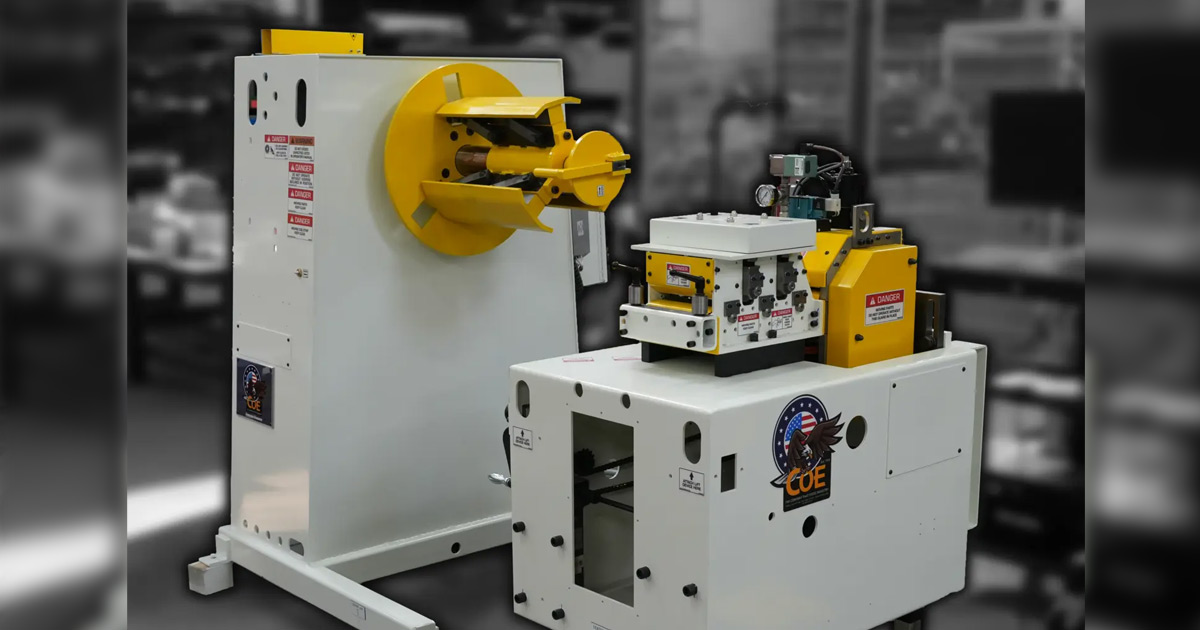
This post breaks down a compact setup built around a 4,000# coil reel, a compact 5-roll pull-thru straightener, and a ServoMaster Series 2 roll feed configured for copper up to 6 inches wide.
Quick Answer
A compact coil processing package for roofing typically combines a coil reel, a straightener, and a roll feed so you can pay off, remove coil set, and feed accurately without a long line or big loop space.
If you’re running narrower strip (like copper for roofing and gutter parts), this kind of compact cell can protect finish, reduce handling, and make changeovers faster in a tight shop.
Key Takeaways
- Compact coil packages work best when your bottleneck is floor space, not line speed.
- Straightening is what turns “coil” into “repeatable parts.” If it’s not flat, nothing downstream behaves.
- A servo roll feed is usually where accuracy is won or lost, especially on short feeds and frequent starts/stops.
- For soft, cosmetic materials like copper, roll condition and setup discipline matter as much as the equipment.
- Keep the reel, straightener, and feed aligned and close-coupled to reduce wander and edge damage.
- Build a quick setup checklist and make it the standard, not tribal knowledge.
Choose Your Focus
What a “Coil Processing Solution” Means
- A matched set of equipment that pays off coil, flattens it, and feeds it consistently into your next operation.
- A way to control coil set so the strip runs stable through tooling.
- A method to hold feed length repeatability so parts stay on-size and scrap stays down.
- A layout that reduces manual handling, which helps both safety and surface finish.
- A configuration sized to your width, thickness, and material so you’re not fighting settings every run.
What’s in the compact system
This compact coil processing solution for roofing was built as a tight three-piece combo:
- 4,000# coil reel (motorized payoff, variable speed): steady payout and controlled tension for smoother feeding.
- Compact 5-roll pull-thru straightener: removes coil set to produce flat, feed-ready material.
- ServoMaster Series 2 roll feed: configured to handle up to 6-inch-wide material with stated ±0.003-inch feed accuracy and a touchscreen interface.
Why these three together: reel controls payout, straightener controls shape, feed controls length. If any one is inconsistent, the whole cell “feels” unstable.
Footprint and layout tips
Compact systems earn their keep when the layout is deliberate:
- Keep the strip path short and straight. Fewer opportunities for side-wander and edge dings.
- Leave working room where it matters: operator access to the straightener entry/exit and feed rolls.
- Plan for coil loading: a “compact” cell still needs safe access for coil change, threading, and scrap removal.
- Cable and air management: avoid trip hazards and keep hoses off the floor near the threading zone.
Accuracy and surface protection
Roofing and gutter components often punish inconsistency: a small feed error can show up as hole mislocation, bad notch alignment, or trimming issues
What helped in this configuration:
- The roll feed is designed for precision, and the system calls out satin chrome non-marking rolls as part of the approach to protect finish.
- Straightening is doing the “quiet work” by stabilizing strip shape before it ever hits the feed. Coil straightening is fundamentally bending and unbending around rolls to remove coil set.
Material fit for roofing and gutters
This specific system was configured for copper up to 6 inches wide. That’s a common sweet spot for smaller roofing and gutter components where you want tight control without a long line.
If you’re using copper coil for building products, ASTM B370 is commonly referenced for copper sheet and strip used in building construction.
Setup and maintenance checklist
Use this as a quick standard work sheet for a compact coil cell:
Before you thread
- Confirm coil ID/OD and weight are within reel capacity (here, up to 4,000 lb).
- Inspect strip edges for damage that can “steer” the strip.
- Verify straightener roll condition and cleanliness.
During threading
- Keep the strip centered through reel → straightener → feed.
- Bring the feed rolls in gradually, confirm no marking on first pass.
First piece
- Measure feed length over multiple strokes, not just one.
- Check flatness coming out of the straightener before blaming the tool.
Weekly
- Check fasteners, guards, and sensor alignment.
- Document the best-known settings for your common copper thicknesses and widths.
FAQ
What is a coil processing solution for roofing?
A coil processing solution for roofing is a reel + straightener + feed setup that pays off coil, removes coil set, and feeds accurate lengths into your next operation, helping you hold part quality in a compact footprint.
Why use a pull-thru straightener in a compact cell?
Pull-thru straighteners can be a good fit when you need coil-set removal without adding a large, complex line. The goal is stable, flat strip so the feeder and tooling don’t fight shape issues.
What problems show up when strip isn’t flat?
Common symptoms include inconsistent feeding, edge wander, premature tooling wear, and dimensional drift. If the strip is unstable, the process becomes “operator-correction dependent.”
How do I protect cosmetic materials like copper?
Start with clean, smooth rolls, consistent threading practices, and controlled payoff tension. Verify first-piece finish and measure for marking before running full speed.